RFID frequencies fall into three main ranges, and each one suits a different job. Low frequency (LF, 125–134 kHz) reads at a few centimetres and copes best near metal and water, high frequency (HF, 13.56 MHz, which includes NFC) reads from a few centimetres to about a metre and suits cards, tickets and smartphone taps, and ultra-high frequency (UHF, 860–960 MHz) reads hundreds of tags at once from several metres away. For counting stock, auditing assets and tracking linen, UHF is the usual choice, provided your readers are set to the UHF band your country allows.
Below we explain how each RFID frequency works, typical read ranges and uses, how metal and liquids change the picture, and what the regional UHF bands mean for projects in Jordan, the Gulf and the wider Middle East. If you are new to the technology, our guide to RFID vs barcode covers the basics first.
Why frequency matters in RFID
Most RFID tags used in business are passive: they have no battery and take their energy from the reader's signal. How that energy reaches the tag depends on the frequency.
- LF and HF use near-field coupling. The reader and the tag each have a coil, and they couple magnetically. The field fades quickly with distance, so reads are short.
- UHF uses radio waves. The tag reflects part of the reader's signal back with its number encoded in it. This is called backscatter, and it works over metres rather than centimetres.
Frequency therefore decides the read range, how many tags can be read at once, how the tag behaves near metal and liquids, and which readers can read it. A reader and a tag must work in the same band: a UHF reader will not read an HF access card.
Low frequency (LF): 125–134 kHz
LF is one of the oldest RFID bands in wide use, and you still meet it every day.
- Typical read range: from touching distance to around 10 cm.
- Strengths: of all the bands, LF is the least affected by water and metal, and it reads through animal tissue.
- Limits: data moves slowly, readers usually handle one tag at a time, memory is small, and the coil antennas make tags relatively bulky.
- Common uses: animal identification at 134.2 kHz under the ISO 11784 and 11785 standards, older 125 kHz access cards and key fobs, car key immobilisers, and some tool tracking in harsh industrial settings.
You will rarely choose LF for stock or assets today, but you may find it in an existing access-control system.
High frequency (HF): 13.56 MHz
HF sits at a single frequency that is available for this use worldwide, so an HF tag reads the same way in Amman, Dubai or London.
- Typical read range: a few centimetres for proximity cards (ISO/IEC 14443), and up to about 1 metre for vicinity tags (ISO/IEC 15693) with a large reader antenna.
- Strengths: works better near liquids than UHF and supports chips with strong security features for access and payment.
- Limits: shorter range and slower bulk reading than UHF. Metal still interferes, so HF tags for metal surfaces use a ferrite layer.
- Common uses: staff access cards and many hotel key cards, transport and event tickets, patient wristbands, some pharmaceutical packaging, smart shelves and document files.
NFC: a special case of HF
Near-field communication (NFC) runs at 13.56 MHz and builds on the same family of standards. Its read range is kept to a few centimetres on purpose, so each read is a deliberate tap on one tag.
The big advantage of NFC is that most smartphones can read it. Staff or customers can tap a tag to open a product page, confirm a product is genuine or see an asset's service history, without special hardware. Phones cannot read UHF tags on their own, which is the main reason to choose NFC for anything the public will interact with.
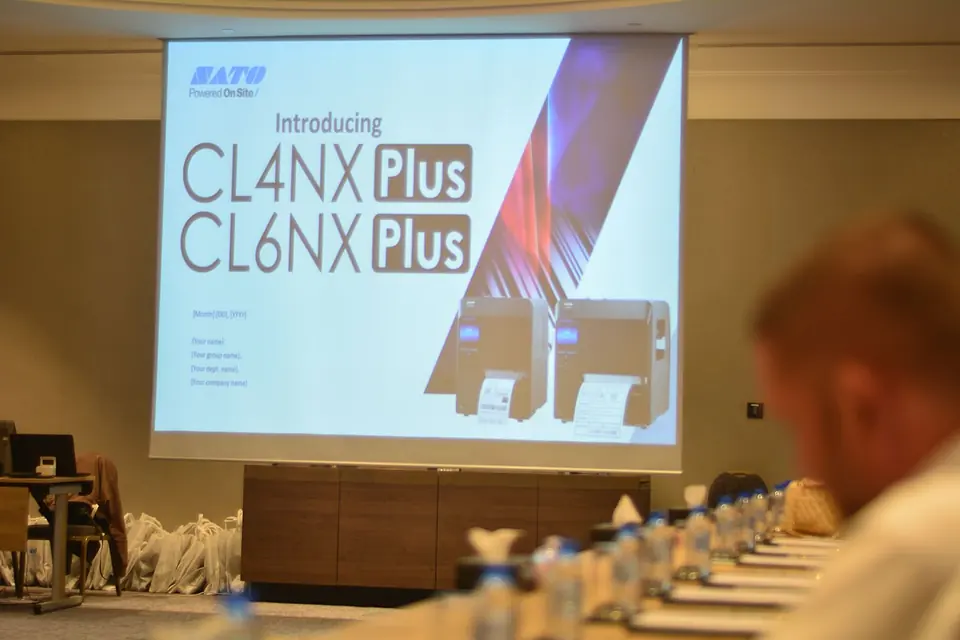
Some RFID printers handle both HF and UHF. The SATO CL4NX Plus, for example, can be configured to encode UHF, HF or NFC labels while printing the face.
Ultra-high frequency (UHF): 860–960 MHz
UHF is the workhorse of modern RFID for stock, assets and laundry. Almost all passive UHF tags follow the EPC Gen2 standard, published as ISO/IEC 18000-63 and also marketed as RAIN RFID, so any Gen2 tag can be read by any Gen2 reader set to a suitable band.
- Typical read range: for passive labels, from around 1 metre to 10 metres or more, depending on the tag size, the reader's power, the antenna and the surroundings. A handheld sweeping a shelf usually works at a few metres; a fixed reader with good antennas reaches further.
- Speed: readers sort out replies from many tags in a fraction of a second, so a person can walk along a rail and count hundreds of items.
- Strengths: long range, fast bulk reads and small, low-cost tags.
- Limits: metal and water have a strong effect, covered below, and long range means reads can spill outside the intended area, so read zones need tuning.
- Common uses: retail stock, warehouse cartons and pallets, fixed assets, hotel and hospital linen, tools, document files and long-range vehicle tags.
Most of the RFID readers we supply are UHF, from pistol-grip handhelds for counts to fixed readers for doorways and overhead readers for whole rooms.
UHF RFID bands in the Middle East, Europe and the US
This is where projects most often go wrong. UHF RFID does not use one frequency worldwide. Each country's telecom regulator decides which part of the 860–960 MHz range RFID readers may use, and at what power. Two plans cover most of the world:
- 865–868 MHz: the band defined by ETSI for Europe, and the one used in much of the Middle East.
- 902–928 MHz: the band set by the FCC in the United States and used across most of the Americas.
Several Asian countries use bands around 920 MHz, and some countries allow more than one band or only part of one. Rules also change from time to time, so do not assume one country's band applies next door.
What this means for your readers
A UHF reader must be configured for the band permitted in the country where it is used. Most readers are sold in regional versions or have a region setting, and a unit bought for the US market is normally set to 902–928 MHz. Outside the Americas, parts of that band are used by mobile networks, so running such a reader can break local rules and interfere with other services.
Permitted transmit power and channel rules also differ by region, so a read range measured under one region's rules may not match what you see under another's.
What this means for your tags
Many passive UHF tags are broadband and read anywhere in 860–960 MHz, but each design is tuned to perform best in part of that range. Our on-metal RFID label, for instance, lists different read ranges for 865–868 MHz and for 902–928 MHz. Compare tags using the figure for your band.
Projects across several countries
If you run sites in Jordan, Saudi Arabia, the UAE or elsewhere in the Gulf, check each country separately and record the region setting on every reader. Check the current rules with the telecom regulator in each country, such as the TRC in Jordan, the CST in Saudi Arabia or the TDRA in the UAE. When NADA-TECH installs readers, we configure them for the country where they will operate.
How metal and liquids affect each frequency
Materials matter at every frequency, but not equally.
- Metal reflects radio signals and detunes tag antennas placed on it. UHF is hit hardest when a standard label sits directly on steel or aluminium. On-metal tags solve this with a spacer and an antenna designed to work with the metal surface. Metal shelving also creates reflections and dead spots, which a site survey picks up.
- Water absorbs UHF energy. Tags on bottles, IV bags or anything worn on the body read at shorter range, while HF and LF are much less affected. With UHF, tags designed for liquids, placement on a cap or neck, and readers at more than one angle help.
- Cardboard, wood, plastic and fabric are easy. UHF passes through them, which is why it can read inside closed cartons. Very dense stacks, such as folded garments, can shadow tags in the middle, so read from more than one side.
Which RFID frequency should you choose?
- Choose UHF when you need to count many items at once, read from a distance or record items passing through doors. This covers stock, warehouses, retail, fixed assets and laundry, and it is the basis of our inventory management solution.
- Choose HF for short, deliberate reads, card-style security, or reads close to liquids: access cards, tickets, wristbands and some pharmacy items.
- Choose NFC when customers or staff need to tap a tag with an ordinary smartphone.
- Choose LF only where existing systems or harsh conditions call for it, such as animal tags, older access systems or some metal-heavy industrial uses.
Some projects combine bands. A hotel may keep HF key cards and add UHF tags for linen and furniture, and dual-frequency tags combine UHF and NFC in one label. If you need to see where an item is in real time, rather than at a count or a doorway, read what an RTLS is to compare.
Once you know the band, the next step is the tag itself. Our guide on how to choose RFID tags covers inlays, labels, on-metal and laundry tags.
Frequently asked questions
What is the read range of UHF RFID?
Passive UHF tags typically read from around 1 to 10 metres or more, depending on the tag, reader, antenna and surroundings. Small tags, tags on metal or liquids, and handheld readers sit at the shorter end.
Is NFC the same as RFID?
NFC is a form of HF RFID at 13.56 MHz, designed for very short, deliberate reads of a few centimetres. Every NFC tag is an RFID tag, but most RFID tags are not NFC.
Can a smartphone read UHF RFID tags?
Not on its own. Phones read NFC tags. To read UHF tags you need a UHF reader, such as a handheld or a reader sled that pairs with a phone or mobile computer.
Which UHF band is used in Jordan and the Gulf?
Much of the Middle East follows the 865–868 MHz plan, but rules differ by country and can change. Check the current permitted band with the telecom regulator in each country before you buy or install readers.
Talk to us about your RFID project
Not sure which RFID frequency fits your items, or which UHF band your readers need? Tell us what you want to track and where, and our team in Amman will recommend tags and readers, configure them for your country and test them on your items before you commit. You can contact us, email sales@nada-tech.com or call +962 7 7766 8097.