Good warehouse labels give every rack location, pallet and carton an identity that a scanner reads first time. In practice that means three families of label: location labels on racks, bins and floors; pallet and carton labels that carry an SSCC or a product code; and shipping labels for the carrier. Match the label material to the environment, print with thermal transfer when a label must last, and follow a few design rules on size, quiet zones and check digits.
This guide covers each one, with the printers, scanners and media we supply to warehouses in Jordan and across the region.
Start with a location naming scheme
Before you print a single rack label, agree on how locations are named. Every label, pick list and WMS record will use the same code, so changing it later is painful.
A common structure is zone, aisle, bay, level and position, for example B-04-12-C-2: zone B, aisle 4, bay 12, level C, position 2. A few rules keep it readable:
- Keep the same length and order everywhere. Use leading zeros (04, not 4) so codes sort correctly in reports.
- Mix letters and numbers on purpose. Letters for levels and numbers for bays, for example, so the two are never confused.
- Avoid look-alike characters. Leave out O and I, which are easily read as 0 and 1.
- Follow the walking route. Number bays in the direction pickers walk, odd on one side of the aisle and even on the other.
Set the scheme up in your WMS first, then print from it, so the labels and the system never disagree.
Rack location labels
Beam labels
Beam labels go on the front face of the rack beam. A common convention is to place each label on the beam directly below the position it identifies; whichever convention you use, apply it everywhere. Add an arrow pointing up or down when there is any doubt about which level a label belongs to.
Print the location code in large, bold characters next to the barcode, so drivers can read it from the forklift seat and staff can key it in if a label is damaged.
High racks and multi-level labels
Labels on the top beams of a high rack are hard to scan from the floor. Common answers are:
- Multi-level labels placed at a reachable height, with one barcode per level and arrows showing which level each belongs to.
- Larger barcodes for upper levels, paired with scanners that read from a longer distance.
- Retro-reflective labels, which are made for long-range scanning.
Test any option with your own scanners at the real working distance.
Bin and shelf labels
Small-parts shelving and picking bins take smaller labels with the bin code and barcode. If your layout changes often, use label holders, magnetic labels or removable adhesive, so you can move a location without scraping off old labels.
Floor locations
Block-stacked pallets on the floor need floor labels or signs. These must survive forklift traffic, cleaning machines and dust, so use heavy-duty floor-marking labels or hanging signs.
Pallet and carton labels
What an SSCC is
An SSCC (Serial Shipping Container Code) is an 18-digit GS1 number that identifies one logistic unit: a pallet, a roll cage or a carton shipped on its own. It is made of an extension digit, your GS1 company prefix, a serial reference and a check digit. Each SSCC belongs to one unit, so never reuse a number for a different pallet.
The SSCC is printed as a GS1-128 barcode with the application identifier (00) in front of it. When your customer scans that one barcode, their system can look up everything on the pallet in the electronic despatch advice, if you send one. To issue SSCCs, you need a GS1 company prefix from your local GS1 member organisation.
The same SSCC can also be encoded in an RFID tag, which is how pallet-level RFID usually works. Our guide to an RFID warehouse management system explains that step.
The GS1 logistic label
A GS1 logistic label is often printed at A6 (105 x 148 mm) or in a 4 x 6 inch format, and it is split into three sections:
- Top: free-form text such as your company name and logo.
- Middle: plain-text data with clear titles, such as product, quantity, batch and dates.
- Bottom: the GS1-128 barcodes, each with a readable line showing the application identifiers in brackets, and the SSCC barcode lowest on the label.
GS1 guidance suggests at least two labels per pallet, on adjacent sides, with the SSCC barcode roughly 400 to 800 mm above the base of the pallet. Check the current GS1 logistic label guideline and any rules your customers set: large retailers and distributors, whether in Amman, Riyadh or Dubai, may have their own supplier labelling requirements.
Carton labels
A carton that leaves your warehouse as a trade unit usually carries its product code (GTIN), printed as an ITF-14 barcode or as GS1-128 with the application identifier (01). Where it matters, add the batch or lot number (10) and the expiry date (17) in the same GS1-128 barcode, so one scan captures everything.
Shipping labels
Courier and parcel labels are usually 4 x 6 inch (around 100 x 150 mm) labels printed from the carrier's system. They only need to last a few days, so direct thermal printing, with no ribbon, is the norm.
Watch the heat. Direct thermal labels darken when exposed to heat and strong light, and a label left in a closed truck or on a sunny loading dock in a Jordanian or Gulf summer can become hard to scan. For anything that sits in a yard or trailer for long, use thermal transfer. Our comparison of thermal transfer vs direct thermal printing explains why.
Label materials
- Paper. Fine for indoor, ambient storage: cartons, shipping labels and most pallet labels.
- Synthetic (polypropylene or polyester). Resists water, oil, tearing and abrasion. Use it for rack labels, outdoor yards, chemical stores and anything that must last for years.
- Freezer and cold store. Use labels with a freezer-grade adhesive. Many adhesives grip poorly when applied to a cold or wet surface, so apply labels before goods go into the cold room where you can, or choose an adhesive rated for cold application.
With thermal transfer, match the ribbon to the label: wax for paper, wax-resin for coated paper that needs extra smudge resistance, and resin for synthetic labels.
Choosing printers for warehouse labels
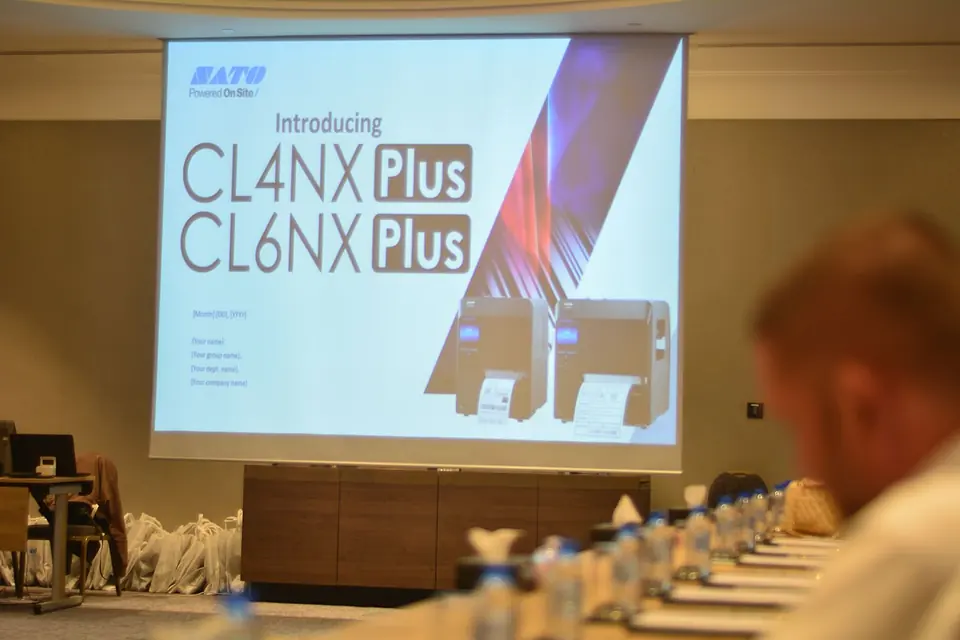
- Industrial printers handle pallet label printing and long runs of carton labels in dispatch and production. The SATO CL4NX has a metal frame, large media capacity and 203, 305 or 609 dpi options, for anything from carton labels to tiny 2D codes.
- Desktop printers suit lower volumes at receiving desks, offices and small stores.
- Mobile printers clip to a belt and print next to the rack or the truck, which suits relabelling and receiving. The iDPRT iMOVE 3pro prints direct thermal labels up to 80 mm wide over Bluetooth, with optional Wi-Fi.
Our guide on how to choose a barcode label printer covers volume, resolution and ribbons.
Choosing scanners
Warehouse scanners get dropped, chilled and covered in dust. A rugged model such as the Zebra DS3600 is sealed to IP65 and IP68, survives repeated drops onto concrete, and its corded models work down to -30 °C for cold rooms. Android mobile computers with a built-in scanner combine scanning with a screen for pick lists and receiving.
Two points to check:
- 2D or 1D. A 2D imager reads both traditional barcodes and 2D codes such as QR and Data Matrix, so it keeps your options open.
- GS1 data. Configure the scanner to pass GS1-128 data in the format your WMS expects, so application identifiers such as (00), (01) and (17) are separated correctly.
Label design tips
- Make text big enough. Location codes should be readable from the distance staff actually work at. Print a sample and read it from the forklift seat before you print the whole warehouse.
- Respect quiet zones. Leave clear space on both sides of a barcode: at least ten times the width of the narrowest bar for Code 128 and GS1-128, and four modules around a QR code.
- Use check digits. GS1 numbers such as SSCC and GTIN end in a check digit that your label software calculates. Code 128 also carries a hidden check character that the scanner verifies. Some warehouses add a short check code to each rack label, which pickers key in to confirm a location when they cannot scan.
- Keep high contrast. Black on white or silver works best. Avoid glossy laminates that glare under warehouse lighting.
- Keep barcode data simple. Encode Latin letters and digits in the barcode, and put product names in Arabic and English in the readable text. Test Arabic text in your label software before you roll out.
- Test in the real environment. Scan sample labels with every device you use, then check them again after a week on the rack, in the freezer or in the yard.
A quick warehouse labelling checklist
- Agree the location naming scheme and load it into your WMS.
- Choose label sizes and materials for each zone: ambient, cold and outdoor.
- Decide on thermal transfer or direct thermal for each label type.
- Set up pallet and carton templates, including SSCC and GS1 data where customers need it.
- Print samples, test them with every scanner, and adjust.
- Label the warehouse zone by zone and verify each location as you go.
You can see how labels, printers, scanners and software come together in our warehouse management solution.
Frequently asked questions
What is an SSCC label?
It is a pallet or carton label carrying an 18-digit Serial Shipping Container Code in a GS1-128 barcode. It identifies one logistic unit, so the receiver can scan it and look up the full contents.
What size should a pallet label be?
A6 (105 x 148 mm) and 4 x 6 inch are common sizes for GS1 logistic labels. Check whether your customers require a specific size or layout.
Which labels work in a freezer?
Use labels with a freezer-grade adhesive, ideally applied before the goods go cold, and print them by thermal transfer on a synthetic or freezer-rated face material.
Should rack location labels be barcode or RFID?
Barcode, in most warehouses. A barcode confirms one exact position because it is read only when the scanner points at it, while an RFID reader may pick up the neighbouring location too.
Planning new warehouse labels, or replacing labels that no longer scan? Send us a sample of your current rack, pallet or shipping labels and we will recommend materials, printers and scanners that suit your site, in Jordan or anywhere in the region. To get started, contact us.