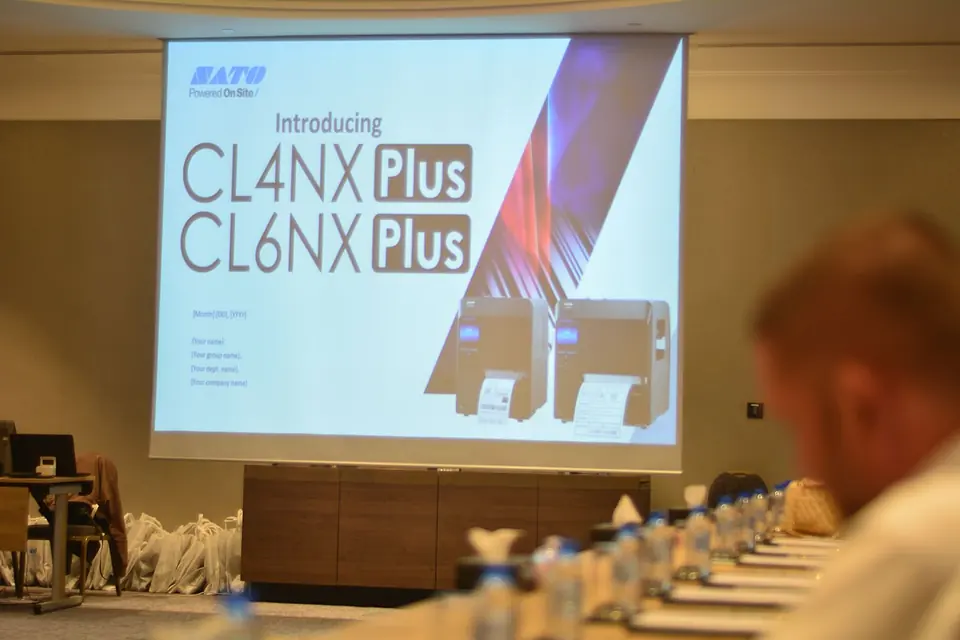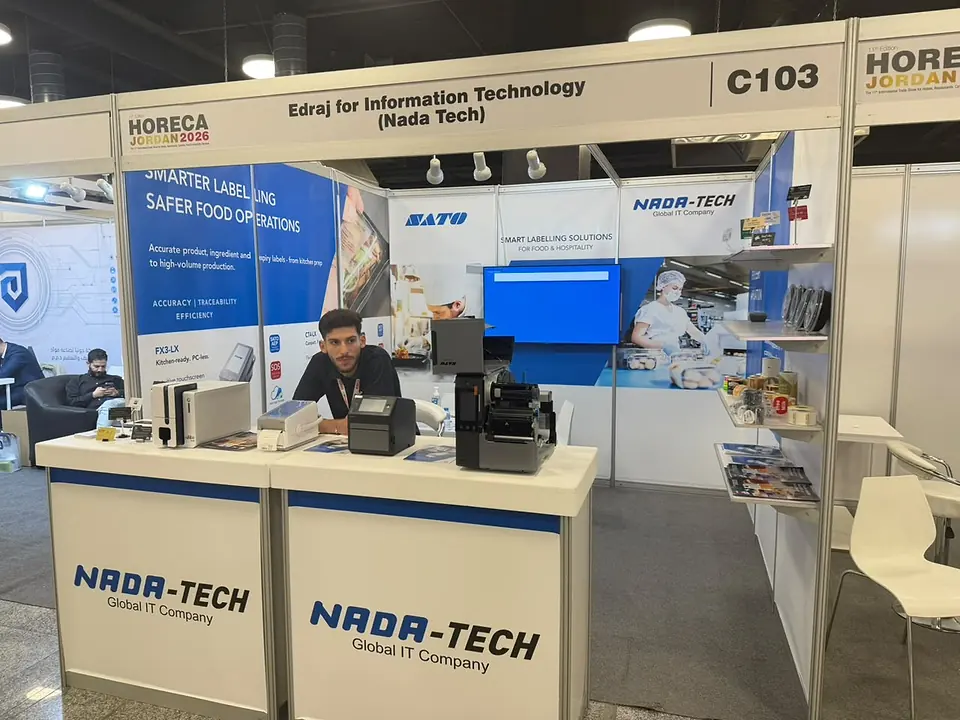
At HORECA Jordan 2026 in Amman in October, NADA-TECH took booth C103 together with SATO to show food labelling for hotel kitchens, buffets and food production. On the counter, SATO kitchen-ready, desktop and industrial label printers printed product, ingredient and expiry labels live, next to an Edikio printer producing buffet and price cards on demand. One line on the booth summed up the idea: smarter labelling, safer food operations.
Here is what we showed at HORECA Jordan 2026, who came to see it, and why food labelling matters for hotel kitchens in Jordan and across the region.
About HORECA Jordan 2026
HORECA Jordan is the international trade show for hotels, restaurants, catering, food and hospitality, held in Amman. The 2026 show was its 11th edition. It brings together hotels, restaurants, caterers and food producers from across Jordan and the region, which makes it a natural place to show how labelling fits into a professional kitchen.
For NADA-TECH, it was a chance to show the hospitality side of our work in one place: the printers, labels and cards that kitchens, buffets and food production teams handle every day.
Booth C103: NADA-TECH with SATO
The booth carried our legal name, Edraj for Information Technology, alongside NADA-TECH and our partner SATO. Two messages framed the stand: "Smart labelling solutions" on the booth wall, and "Smarter labelling, safer food operations" on the banner above the printer counter.
The booth was laid out so visitors could follow labelling from the kitchen to the buffet:
- a printer counter with live demonstrations on SATO printers
- an Edikio card printer with printed buffet and VIP cards beside it
- shelves of food labels, day labels, ribbons, label rolls and brochures
- a video screen beside the label displays
What we showed
Kitchen-ready label printers
The kitchen printer featured on the booth poster was the SATO FX3-LX, a compact 3-inch label printer made for kitchens. A cook taps a product on its touch screen and the label prints with the preparation and expiry dates already worked out, with no computer and no handwriting.
For a hotel kitchen, three practical questions usually come first: will it cope with splashes, does it work with gloves on, and can it print in Arabic? The FX3-LX is splash-resistant to IPX2 with an antibacterial casing, its screen responds to pressure so it works through gloves, and it prints labels in 47 languages, including Arabic. It prints by direct thermal, so the only consumable is the label roll.
Desktop and industrial printers
Next to the kitchen printer, SATO desktop and industrial label printers printed accurate product, ingredient and expiry labels live. Together they cover the range of a food operation, from kitchen prep to high-volume production:
- Kitchen-ready printers at the prep station, for day labels and Made, Ready and Discard dates.
- Desktop printers for stores, pastry sections, delis and smaller production runs.
- Industrial printers for central kitchens, catering units and food production, where labels are printed in high volume all day.
The team ran live prints on a SATO industrial printer, so visitors could watch labels come off the printer and check the result on the label itself.
Edikio buffet and price cards
An Edikio printer produced buffet and price cards on demand: rigid cards ready to slide into a holder on the buffet or a pastry counter, with printed buffet and VIP cards on display beside it. The Edikio Guest Flex prints long buffet tags and credit-card size cards in full colour or white on black, from templates designed on a PC or Mac. Its software includes an allergen feature and is available in Arabic, and one template can carry the dish name in both Arabic and English.
Labels, ribbons and label rolls
The shelves showed the consumables hotels use every day: food labels, day labels, ribbons and label rolls. They are easy to overlook when choosing a printer, but they decide how a label looks, how long it lasts and how often it has to be reprinted.
- Direct thermal labels need no ribbon and suit short-life kitchen labels, such as day and prep labels.
- Thermal transfer printing uses a ribbon and suits labels that must stay readable for longer, such as product labels in storage.
- Day-colour rolls have the colour pre-printed, and the printer adds the product details and dates.
Who we met
During the show the team welcomed chefs, hotel managers, caterers and an official delegation, and walked each group through how labelling supports three things in a professional kitchen:
- Accuracy: a printed label shows the same product name, dates and allergens every time, with no handwriting to misread and no dates to work out in a hurry.
- Traceability: the preparation date, the discard date and who prepared an item stay on the container, so a supervisor can check it at any point.
- Efficiency: printing a label takes a tap, and the dates are calculated for you, so cooks spend their time cooking.
Each of these roles tends to see labelling from a different angle. A chef thinks about the prep station and the next shift, a hotel manager about the same standard in every outlet, and a caterer about volume and food that travels. Good labelling has to work for all of them at once.
Why food labelling matters for hotel kitchens
A hotel kitchen prepares food in advance, stores it across several chillers and outlets, and serves guests with very different dietary needs. Labels are how the kitchen keeps control of all of that.
- Shelf life: Made, Ready and Discard labels show when an item was prepared, when it can be used and when it must be thrown away.
- First in, first out: day-colour labels make older stock easy to spot in a walk-in chiller, so it is used first.
- Allergens: allergen information follows a dish from the prep label to the buffet card, so staff and guests can rely on it.
- Checks and inspections: uniform, readable labels make daily checks quicker and support your HACCP plan.
Labels alone do not make a kitchen compliant. The exact requirements come from your HACCP plan, your brand standards and your regulator, so check the current rules with them before you design your labels.
For the detail, including what each label should show and how to set up labelling across several outlets, read our guide to food safety labels for hotel kitchens. For the guest-facing side, see buffet cards and price tags for hotels.
From the show floor to your kitchen
What we showed at HORECA Jordan is the same equipment we supply, install and support for hotels, restaurants and caterers. A labelling project usually follows these steps:
- Review your products, shelf lives, outlets and current labels.
- Choose printers for each station, from kitchen-ready to industrial.
- Build templates for food labels and buffet cards in English and Arabic.
- Supply consumables: labels, cards, ribbons and label rolls.
- Train each kitchen team and the food and beverage office, then support them after go-live.
In a hotel, that usually means a kitchen-ready printer at each main prep area, such as the main kitchen, the banqueting kitchen, pastry and room service, with a desktop printer in the stores and a card printer in the food and beverage office. A central kitchen that prepares food for several outlets or for outside catering is where an industrial printer earns its place, because it prints long runs of product labels without stopping.
Our labelling printers page lists the printers and consumables we supply from Amman for food operations in Jordan and the wider Middle East.
Frequently asked questions
Where was NADA-TECH at HORECA Jordan 2026?
At booth C103, together with SATO, in the HORECA Jordan exhibition hall in Amman, in October 2026.
Which printers did NADA-TECH show?
SATO kitchen-ready, desktop and industrial label printers, with the FX3-LX kitchen printer featured on the booth poster, and an Edikio printer for buffet and price cards.
Can the labels and cards print in Arabic?
Yes. The SATO FX3-LX prints labels in 47 languages, including Arabic, and the Edikio Guest software works in 22 languages, including Arabic.
I missed the show. Can I still see the printers?
Yes. Get in touch and we will arrange to show you the kitchen label printer and the buffet card printer with your own products and menu.
The full photo gallery from booth C103 is on our HORECA Jordan 2026 event page. If you missed us at the show and want to see how food labelling would work in your kitchen, contact us and we will set up a demonstration.